
Documentation Index
Fetch the complete documentation index at: https://docs.raycaster.ai/llms.txt
Use this file to discover all available pages before exploring further.
Overview
Raycaster’s CRM syncing system lets you move data between your CRM (HubSpot or Salesforce) and your Raycaster sheets. You can pull CRM records into sheets for AI-powered enrichment, then push the results back to your CRM.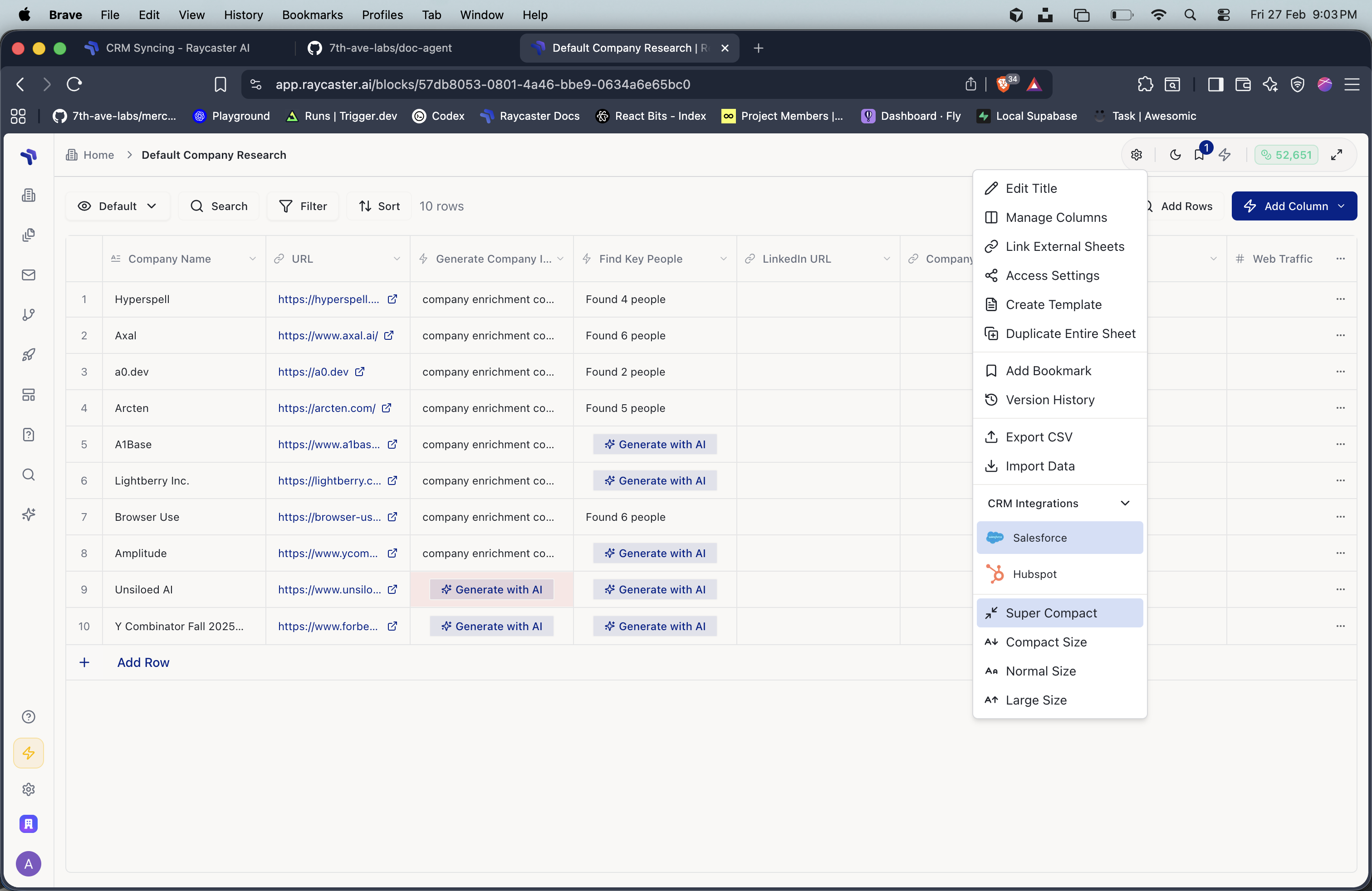
Sync Directions
- Pull
- Push
- Bidirectional
CRM → Raycaster SheetImport contacts, companies, or accounts from your CRM into a Raycaster sheet.When to use:
- Starting a new research project with existing CRM data
- Bringing in contacts for AI-powered enrichment or outreach
- Creating a working copy of CRM data for analysis
- Raycaster queries your CRM for records matching the configured entity type
- Mapped fields are extracted from each record
- New rows are created in your sheet with the CRM data
Field Mapping
Field mapping defines how your sheet columns correspond to CRM fields. This is the core of the sync configuration.How Field Mapping Works
Each mapping is a pair: Sheet Column ↔ CRM Field| Sheet Column | HubSpot Field | Salesforce Field |
|---|---|---|
| First Name | firstname | FirstName |
| Last Name | lastname | LastName |
email | Email | |
| Company | company | Account.Name |
| Phone | phone | Phone |
| Job Title | jobtitle | Title |
Standard vs Custom Fields
Both standard and custom CRM fields are supported:- Standard fields — Built-in fields like Name, Email, Phone that exist in every CRM
- Custom fields — Fields your team has added to your CRM (e.g., HubSpot custom properties or Salesforce fields ending in
__c)
Mapping Best Practices
Always map a unique identifier
Always map a unique identifier
Include a unique field like
Email in your mappings. This helps prevent duplicate records and enables future deduplication.Map only the fields you need
Map only the fields you need
You don’t need to map every CRM field. Map only the columns relevant to your current workflow to keep your sheet focused.
Use CRM templates for quick setup
Use CRM templates for quick setup
CRM templates come with pre-configured columns that match common CRM fields, reducing the time spent on manual mapping.
Entity Types
Contacts / People
Sync individual contact records:- HubSpot: Contacts object
- Salesforce: Contact object
- Unique key: Email address
Companies / Accounts
Sync organization records:- HubSpot: Companies object
- Salesforce: Account object
- Unique key: Company name or domain
CRM Templates
Raycaster provides pre-built sheet templates optimized for CRM data:| Template | Description | Entity Type |
|---|---|---|
| People Template for CRMs | Columns for contact data: name, email, phone, title, company | Contacts |
| Company/Accounts Template for CRMs | Columns for company data: name, domain, industry, size, location | Companies/Accounts |
- Pre-defined columns matching common CRM fields
- Faster field mapping setup
- Consistent structure across your team’s sheets
Sync Events and Tracking
Every sync operation is recorded with detailed tracking:- Event type — What type of sync was performed (pull, push, bidirectional)
- Records processed — Total number of records handled
- Successes — Records that synced without issues
- Errors — Records that failed, with specific error messages
- Duration — How long the sync took
Workflow Example
Here’s a typical workflow combining CRM sync with Raycaster’s research capabilities:Pull Contacts from CRM
Create a sheet from the “People Template for CRMs” and pull your target contacts from HubSpot or Salesforce.
Enrich with AI Research
Add research columns to find publications, patents, or company intelligence for each contact.
Generate Outreach
Use the AI-enriched data to generate personalized outbound messages for each contact.