
Documentation Index
Fetch the complete documentation index at: https://docs.raycaster.ai/llms.txt
Use this file to discover all available pages before exploring further.
Overview
Agentic Review lets you define review programs — reusable configurations that describe how the AI should review documents — and execute review runs against target documents. The AI analyzes each document and produces structured action items for human review.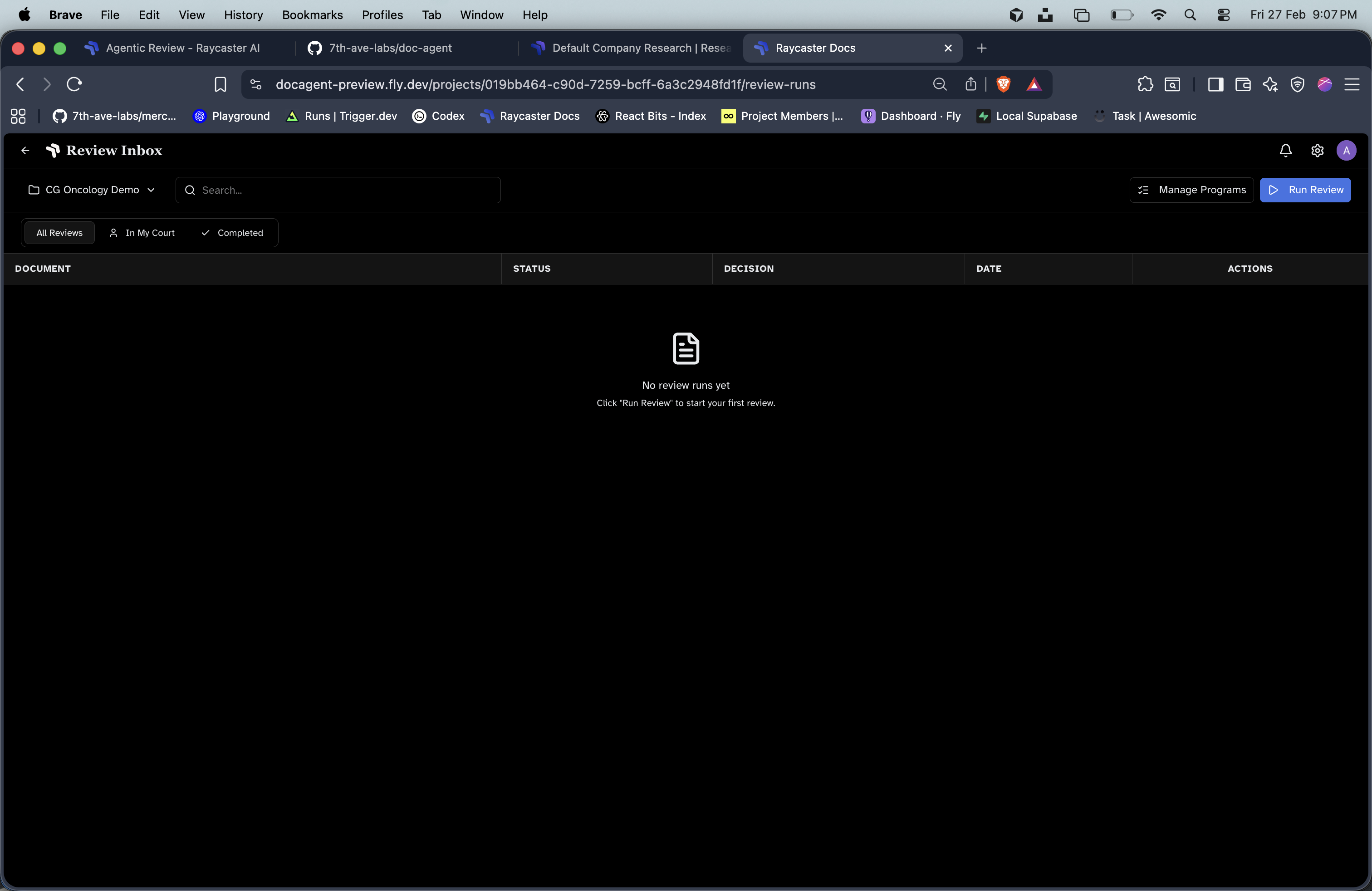
Core Concepts
Review Program
A reusable template with review instructions and reference guideline files.
Review Run
A single execution of a program against selected documents, producing action items.
Action Items
Specific findings with title, description, location, and severity.
Creating a Review Program
Write the review prompt
Describe what the AI should look for — compliance gaps, formatting issues, missing sections, etc.
Attach guideline files
Select reference documents from your workspace that the AI should use as review criteria.
Running a Review
- Select a review program
- Choose the target documents to review
- Optionally set a due date
- Start the review — the AI runs autonomously
Action Items
Each action item includes:| Field | Description |
|---|---|
| Title | 5-10 word summary of the finding |
| Description | 1-2 sentence explanation |
| Location | Page number and section reference |
| Severity | info, warning, or error |
Disposition Codes
After the AI completes its review, a human reviewer assigns a final disposition code. Raycaster Doc supports multiple presets:| Preset | Codes | Use Case |
|---|---|---|
| EPC | A, B, C, D | Construction document review |
| Life Sciences | Approved, Conditional, Revise, Rejected | Pharma/biotech QA |
| BLA Submission | BLA Ready, Minor Deficiency, Major Deficiency, Refuse to File | FDA regulatory |
| Simple | Approved, Changes, Rejected | General review |